CRIME FIGHTERS

Wednesday, 16 July 2014

REVEALED: Shocking failure to police drink-spiking in Spanish resorts

POLICE in Spain have apparently no official records for the crime of drink-spiking. Hospitals and town halls have also failed to give any indication of the severity of the problem, despite a terrifying 60% increase in sexual attacks in Spanish resorts last year. The shocking revelation comes as assaults from spiking begin to soar, with the summer season now well underway. “It is clearly becoming a bigger issue and particularly in the summer,” said a source at Marbella Town Hall.

We cannot see our greatest selves beyond giant shame trees that provides shade for our demons of guilt

 while we sweat in the harshness of the midday sun of our hang-ups, begging to believe we are worthy.

Released Alien from Border Crisis Arrested for Alleged Murder, Kidnapping in Texas

An illegal immigrant who was released by U.S. authorities with a Notice to Appear has been arrested for the alleged murder of a woman and kidnapping of children on U.S. soil. The alleged crimes occurred after the man was released. The man, Pedro Alberto Monterroso-Navas, entered the U.S. illegally with children and turned himself in to U.S. Border Patrol agents. He was processed and released, as are all illegal immigrants who come as unaccompanied minors or incomplete family units from Central America. The alien is from Honduras. The arrest was first reported by the Associated Press (AP), but Breitbart Texas has exclusively confirmed that the man was part of the Obama Administration’s catch and release policy for family groups from Central America. A U.S. Border Patrol source who spoke with Breitbart Texas on the condition of anonymity provided Breitbart Texas with the alien registration number for the man, and the event number for the man’s apprehension. He was processed in the McAllen station of the U.S. Border Patrol. The alien’s registration number is 202027386. The event number for his apprehension is MCS14061487. The “MCS” designates the McAllen station, the “1406” designates that the man was apprehended in June of 2014. A separate Border Patrol source confirmed that the man was apprehended on June 26, 2014 with two children he claimed were his own. He told U.S. authorities he had family in Metairie, Louisiana.

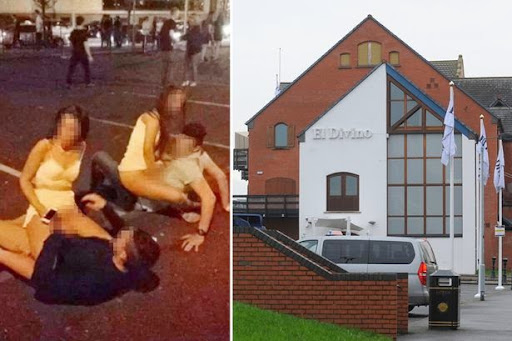
Shocking images showing two couples having sex outside nightclub sparks outrage online

This is the shocking photograph showing two couples having sex outside a nightclub. Two scantily clad girls are pictured sitting on boys’ laps in a car park outside Ed Divino in Belfast as other stunned revellers looked on. The jaw-dropping snap of the two couples, taken last Thursday, has gone viral with people posting their disgust online. One twitter post reads: “WTF is wrong with the young ones did they not learn after magaluf girl n slanegirl now another pic pops up :(.” Another posted: “People have no shame. This is traumatic.”

El Divino nightclub, Belfast: Picture of clubbers having sex in car park posted on Twitter, Instagram and Facebook sparks outrage

A picture of two female clubbers appearing to have sex with two men in a car park outside a nightclub has sparked outrage online. The image has been shared on thousands of social media accounts after being taken outside El Divino in Belfast after a student night last Thursday. It shows the two scantily-clad women on top of the men, with other revellers milling in the background, in scenes reminiscent of the recent video of a clubber giving oral sex to men in return for a drink in Magaluf.

British cyber-jihadist Babar Ahmad jailed in US

A British cyber-jihadist has been sentenced in a US court to 12-and-a-half years' imprisonment after admitting terrorism offences. Babar Ahmad, of Tooting, south London, had admitted conspiracy and providing material to support the Taliban. Ahmad has already spent almost 10 years in prison in the UK and US and his lawyer thinks he could be released in about seven-and-a-half months. He waived his right to an appeal as part of a plea agreement. The judge said she had to weigh the seriousness of the crime with Ahmad's good character, after reading thousands of letters of support and hearing from British prison officials who described him as an exemplary prisoner. The court in New Haven, Connecticut, handed down a sentence of 150 months, half of the 25 years the prosecution was seeking. Ahmad is expected to carry out the remainder of his sentence in New York's Metropolitan Correctional Center.

Tuesday, 22 January 2013

Ms Sandiford to be executed for drug trafficking.

A British grandmother has been sentenced to death by firing squad for smuggling almost 5kg of cocaine into Bali.

Lindsay Sandiford was arrested in May last year after she tried to enter the Indonesian holiday island with illegal drugs worth £1.6 million hidden in her suitcase.

Local prosecutors had called for the 56-year-old housewife to be jailed for 15 years. But today there were gasps in the Bali courtroom when a panel of judges announced Ms Sandiford would be executed for drug trafficking.

As the shock verdict was announced, Ms Sandiford, from Gloucestershire, slumped back in her chair in tears before hiding her face with a brown sarong as she was led out of the courtroom.

Tuesday, 28 August 2012

Amber Gold affair is one of the biggest financial scandals to hit Poland since the fall of communism in 1989.

It was pretty much all the money Bozena Oracz had after a working life as an accountant: the equivalent of $15,000. She placed it in a fund investing in gold, with the hope of paying for her daughter's studies and getting treatment for a bad knee.

Those dreams were dashed when she discovered she had fallen victim to an elaborate fraud scheme that has left thousands of Poles, many of them elderly, facing financial ruin.

The so-called Amber Gold affair is one of the biggest financial scandals to hit Poland since the fall of communism in 1989. The extent of wrongdoing is still murky, but it seems to have some elements of a pyramid scheme, meaning the financial institutionused funds from new clients to pay off older clients rather than investing them.

Consumed with anger and desperation, 58-year-old Oracz traveled last week from a small town near Warsaw to a law firm in the capital to consider whether, after losing 50,000 zlotys, she should risk another 3,000 zlotys ($920; €730) on the fee to join a class-action lawsuit seeking to recover some of the losses.

"This was a lot of money to me — it was my savings," Oracz said, fighting back tears. Now retired and living on a small pension, she sees no way of building another nest egg. "My pension barely covers my needs," she said.

The affair has raised questions about the effectiveness of Poland's justice system and government because authorities failed to act against the scheme despite red flags from regulators and the criminal record of its young owner. Scrutiny has also focused on the prime minister due to business dealings his son had with those running the scheme. The scandal has even touched democracy icon Lech Walesa, who fears it could tarnish his good name.

Prosecutors say investors lost about 163 million zlotys ($50 million; €40 million), a number that has been mounting as more and more victims come forward. Any law suits could take care years to go through the courts, with no guarantee of their outcome.

"People are desperate," said Pawel Borowski, a lawyer preparing the class-action suit that Oracz is considering joining. "In most cases the clients lost life savings or sold family properties to make investments."

The financial institution, Amber Gold, promised guaranteed returns of 10 to 14 percent a year for what it claimed were investments in gold. Many of its clients were older Poles who grew up under communism and lacked the savvy to question how a financial firm could guarantee such a high return on a commodity whose value fluctuates on the international market. The promised returns compared well to the 3 to 5 percent interest offered by banks on savings accounts — earnings essentially wiped out by the country's 4 percent inflation rate.

"These were people with a low level of financial education," said Piotr Bujak, the chief economist for Poland at Nordea Markets. "They think it's still like in the old times, where everything was guaranteed by the state. They underestimated the risk."

Amber Gold launched in 2009, opening branches in city centers alongside respected banks, with white leather sofas and other sleek touches that conveyed sophistication and respectability. It bombarded Poles with convincing advertisements. Some early investors got out with their expected gains, adding to the fund's credibility.

The company, based in Gdansk, capitalized on gold's allure while playing on people's anxieties in unpredictable financial times. "We are dealing with a loss of confidence in the entire financial system and an urgent need for safe investments," one ad said. "The environment for gold is perfect."

Amber Gold drew in 50,000 investors over its three years of operation, though the company's founder, Marcin Plichta, said there were only about 7,000 at the time of liquidation.

Soon after Amber Gold began operations, the Polish Financial Supervision Authority put it on a "black list" of institutions that operate like banks without authorization. There are 17 other such black-listed institutions in operation, but the regulators lack the authority to shut them down. This has sparked a debate in the government and news media about whether courts should be more aggressive in intervening.

According to prosecutors, the company did use some of its money to invest in at least one legitimate business: It was the main investor in budget airline OLT Express. It was this investment that brought Amber Gold down — when the airline filed for bankruptcy, Amber Gold entered liquidation and its scheme of investments unraveled. Its bank accounts were blocked and it was unable to return the money of thousands of its customers.

Plichta was charged this month with six counts of criminal misconduct.

Prime Minister Donald Tusk's center-right government went into damage-control mode when it emerged that the leader's son, Michal Tusk, had done PR work for the airline. Tusk said he had warned his son against doing business with Plichta but that ultimately he son makes his own decisions.

Leszek Miller, the head of the opposition Democratic Left Alliance, asked how Tusk could warn his son against involvement in the airline but not warn the thousands of Poles who invested in the fund. Miller has called for a parliamentary inquiry into the scandal.

Public discontent is also centering on the justice system because Plichta, 28, has past convictions for fraud, and many Poles are asking why authorities — aware of his criminal record — didn't stop him sooner. Born Marcin Stefanski, he took his wife's last name to distance himself from his past crimes.

The country's top prosecutor, Andrzej Seremet, admitted Monday that prosecutors were negligent in failing to heed multiple warnings since 2009 about Amber Gold from the financial supervisory body. He announced personnel changes in the office he blamed for mistakes.

The affair also has an unlikely connection to the Solidarity leader and former president, Lech Walesa, because an Oscar-winning director, Andrzej Wajda, was relying on money from Amber Gold to produce a film about Walesa's struggle in the 1980s.

Walesa came out publicly to make clear he is not involved in any way, saying he doesn't want his name "dirtied."

Many of the unlucky investors are not only furious but wracked by shame and guilt.

Engineer Andrzej Malinowski, 61, put three months of salary — 25,000 zlotys ($7,660; €6,100) — into Amber Gold. He made the investment without consulting with his wife, sensing that there was some risk and that she would not have agreed.

Now he is so shaken and embarrassed that he doesn't want to talk about it, leaving his wife, Danuta Malinowska, to help unravel the mess.

"He saw that gold was going higher and higher so he believed that maybe it would be a good deal," Malinowska said. "Now he has so much guilt that I am trying to help — contacting the lawyer, filling in the forms, writing to the prosecutors. But the justice system is very ineffective. I don't believe we will be getting any of this money back."

Monday, 27 August 2012

Miguel Angel Trevino Morales new leader is emerging at the head of one of Mexico's most feared drug cartels.

  • Mexico Drug War Zetas_Plan.jpg

    This undated image taken from the Mexican Attorney General's Office rewards program website on Aug. 23, 2012, shows the alleged leader of Zetas drug cartel, Miguel Angel Trevino Morales, alias âZ-40.â (AP Photo/Mexican Attorney General's Office website)

Mexico's Violent Zetas Cartel Sees New Leader Miguel Angel Trevino Morales A split in the leadership of Mexico's violent Zetas cartel has led to the rise of Miguel Angel Trevino Morales, a man so feared that one rival has called for a grand alliance to confront a gang chief blamed for a new round of bloodshed in the country's once relatively tranquil central states.

Trevino, a former cartel enforcer who apparently has seized leadership of the gang from Zetas founder Heriberto Lazcano Lazcano, is described by lawmen and competing drug capos as a brutal assassin who favors getting rid of foes by stuffing them into oil drums, dousing them with gasoline and setting them on fire, a practice known as a "guiso," or "cook-out".

Law enforcement officials confirm that Trevino appears to have taken effective control of the Zetas, the hemisphere's most violent criminal organization, which has been blamed for a large share of the tens of thousands of deaths in Mexico's war on drugs, though other gangs too have repeatedly committed mass slayings.

"There was a lot of talk that he was pushing really hard on Lazcano Lazcano and was basically taking over the Zetas, because he had the personality, he was the guy who was out there basically fighting in the streets with the troops," said Jere Miles, a Zetas expert and U.S. Immigration and Customs Enforcement special agent who was posted in Mexico until last year.

"Lazcano Lazcano, at the beginning he was kind of happy just to sit back and let Trevino do this, but I don't think he understood how that works in the criminal underworld," Miles said. "When you allow someone to take that much power, and get out in front like that, pretty soon the people start paying loyalty to him and they quit paying to Lazcano."

The rise has so alarmed at least one gang chieftain that he has called for gangs, drug cartels, civic groups and even the government to form a united front to fight Trevino Morales, known as "Z-40," whom he blamed for most of Mexico's violence.

"Let's unite and form a common front against the Zetas, and particularly against Z-40, Miguel Angel Trevino Morales, because this person with his unbridled ambition has caused so much terror and confusion in our country," said a man identified as Servando Gomez, leader of the Knights Templar cartel, in a viedo posted Tuesday on the internet.

A Mexican law enforcement official who wasn't authorized to speak on the record said the video appeared to be genuine,

"He is the main cause of everything that is happening in Mexico, the robberies, kidnappings, extortion," Gomez is heard saying on the tape. "We are inviting all the groups ... everyone to form a common front to attack Z-40 and put an end to him."

Trevino Morales has a fearsome reputation. "If you get called to a meeting with him, you're not going to come out of that meeting," said a U.S. law-enforcement official in Mexico City, who spoke on condition of anonymity because of the sensitivity of the topic.

In two years since Zetas split with their former allies in the Gulf cartel — a split in which Trevino reported played a central role — the gang has become one of Mexico's two main cartels, and is battling the rival Sinaloa cartel.

Now the Zetas' internal disputes have added to the violence of the conflict between gangs. Internal feuds spilled out into pitched battles in the normally quiet north-central state of San Luis Potosi in mid-August, when police found a van stuffed with 14 executed bodies.

San Luis Potosi state Attorney General Miguel Angel Garcia Covarrubias told local media that a 15th man who apparently survived the massacre told investigators that both the killers and the victims were Zetas. "It was a rivalry with the same organized crime group," Garcia Covarrubias said.

The leadership dispute also may have opened the door to lesser regional figures in the Zetas gang to step forward and rebel, analysts and officials said.

Analysts say that a local Zetas leader in the neighboring state of Zacatecas, Ivan Velazquez Caballero, "The Taliban," was apparently trying to challenge Trevino Morales' leadership grab, and that the 14 bullet-ridden bodies left in the van were The Taliban's men, left there as a visible warning by Trevino Morales' underlings.

The Taliban's territory, Zacatecas, appears to have been a hot spot in Trevino's dispute with Lazcano. It was in Zacatecas that a professionally printed banner was hung in a city park, accusing Lazcano of betraying fellow Zetas and turning them in to the police.

Trevino began his career as a teenage gofer for the Los Tejas gang, which controlled most crime in his hometown of Nuevo Laredo, across the border from the city of Laredo, Texas, officials say.

Around 2005, Trevino Morales was promoted to boss of the Nuevo Laredo territory, or "plaza" and given responsibility for fighting off the Sinaloa cartel's attempt to seize control of its drug-smuggling routes. He orchestrated a series of killings on the U.S. side of the border, several by a group of young U.S. citizens who gunned down their victims on the streets of the American city. American officials believe the hit men also carried out an unknown number of killings on the Mexican side of the border, the U.S. official said.

Trevino Morales is on Mexico's most-wanted list, with a reward of 30 million pesos ($2.28 million) offered for information leading to his capture.

Raul Benitez, a security expert at Mexico's National Autonomous University, said that the Zetas are inherently an unstable cartel with an already huge capacity for violence, and the possibility of more if they begin fighting internal disputes. "I think the Zetas are having problems, and there is no central command," he said.

The Zetas have been steadily expanding their influence and reaching into Central America in recent years, constructing a route for trafficking drugs that offloads Colombian cocaine in Honduras, ships it overland along Mexico's Gulf Coast and runs into over the border through Trevino Morales' old stomping grounds.

Samuel Logan, managing director of the security analysis firm Southern Pulse, notes that "personality-wise they (Trevino Morales and Lazcano) couldn't be more different," and believes the two may want to take the cartel in different directions. The stakes in who wins the dispute could be large for Mexico; Lazcano is believed to be more steady, more of a survivor who might have an interest in preserving the cartel as a stable organization.

"Lazcano may be someone who would take the Zetas in a direction where they'd become less of a thorn in the side for the new political administration," Logan said in reference to Enrique Pena Nieto, who is expected to take office as president on Dec. 1. "In contrast, Trevino is someone who wants to fight the fight."

Referring to Ignacio "Nacho" Coronel, a member of the rival Sinaloa Cartel who died in a shootout with soldiers in July 2010, Logan noted, "Trevino is someone who is going to want to go out, like Nacho Coronel went out, with his guns blazing."


Laurence Kilby, 40, of Cheltenham, who built and raced cars, was arrested after police seized cocaine with a street value of £1m.


Laurence Kilby, 40, of Cheltenham, who built and raced cars, was arrested after police seized cocaine with a street value of £1m.

A "privileged" racing driver has been jailed with 11 other drug smugglers. Crown Court heard he was head of a gang moving drugs from Eastern Europe along the M4 corridor to London, western England and south Wales.

Kilby was heavily in debt and turned to crime to maintain his lifestyle of fast cars and high living.

Raids on properties

Kilby was jailed in June but his conviction, and those of the rest of the gang, can now be reported following the conclusion of another trial.

In an undercover operation between Gloucestershire and Avon and Somerset Police, officers seized 3kg of cocaine as it was being ferried between London and Cheltenham in October 2010.

Another 1kg of the drug was intercepted in Cheltenham in February 2011 and 2.5kg was discovered in raids on properties in Cheltenham, Staverton, Bristol and London in July 2011.

The gang of 12 drug dealers from Gloucestershire, Bristol and London received sentences of between 18 years and four years seven months.

It can now be reported Kilby, who was jailed in June, and Vladan Vujovic, 43, of Grange Road, London were found guilty of conspiracy to supply Class A drugs. Both were jailed for 18 years.

Laurence Kilby racing in the 2009 Castle Combe Saloon Car ChampionshipKilby built and raced cars with the company he owned, Ajec Racing

Richard Jones, 42, of Bradley Stoke, Bristol, was sentenced to 15 years for the same offence, and Mark Poole, 47, from Portishead, was sentenced to nine years seven months after pleading guilty to conspiracy to supply Class A drugs.

Police said Kilby sourced the drug in London from an East European criminal gang, which included Vujovic.

Vujovic ran a baggage handling company at Heathrow Airport and was said to receive the cocaine before it was distributed around the South West and Wales.

Kilby is the former husband of Flora Vestey, daughter of Lord Vestey, and was owner of motor racing firm Ajec Racing which was based in Staverton.

He was heavily in debt and turned to crime to maintain his lifestyle of fast cars and high living.

'Well-connected socialite'

In a separate charge, Kilby also pleaded guilty to stealing money from the charity Help for Heroes and was sentenced to 10 months, to run concurrently with his 18-year sentence.

He organised a charity race day at Gloucestershire Airport in July 2010, but failed to pass on between £3,500 and £4,000 in proceeds to the charity Help for Heroes.

Det Insp Steve Bean, from Gloucestershire Police, said Kilby was the main man.

"He portrayed himself as a well-connected socialite and businessman, whilst indulging his ambition as a minor league racing driver.

Drugs wrapped in plastic packagesPolice seized 6.5kg of drugs during the operation

"Despite a privileged background, the reality was that his lifestyle was funded by the ill-gotten gains of drug dealing.

"He continually lied and blamed others in an attempt to distance himself from the conspiracy.

"He displayed an air of arrogance and thought he could get away with it because he didn't get his hands dirty."

The majority of the gang were jailed in June, but reporting restrictions meant it could not be reported until now, after the sentencing of the remaining gang members.

Others members of the gang to be sentenced were:

  • David Chapman, 29, from Bourton-on-the-Water, Gloucestershire, pleaded guilty to possession with intent to supply and was sentenced to nine years.
  • William Garnier, 31, from Cheltenham, pleaded guilty to supplying Class A drugs and was sentenced six years and eight months.
  • Garry Burrell, 46, from Easton, Bristol, and John Tomlin, 28, from Newtown, Gloucestershire both pleaded guilty to possession of cocaine and were sentenced to six years and six months and four years and six months respectively.
  • Timothy Taylor, 40, from Bristol was found guilty of supplying Class A drugs and was sentenced to four years and seven months.
  • Brian Barrett, 48, from Keynsham was found guilty of conspiracy to supply Class A drugs and was sentenced to 10 years.
  • Scott Everest, 39, from Clevedon was found guilty of conspiracy to supply Class A drugs and was jailed for seven years.

Jonathan Tanner, 45, from Warminster was sentenced to 18 months for possession with intent to supply of cannabis, but was cleared of conspiracy to supply Class A drugs.

Darren Weetch, 38, from Bristol, pleaded guilty to possession of cocaine with intent to supply. He was sentenced to 16 months.

Officers also worked with Thames Valley Police and the Metropolitan Police during the operation.

Saturday, 25 August 2012

The nine people believed injured by stray police gunfire outside the Empire State Building were not the first to learn how dangerous a crowded street can be in a gunfight.

 Civilians occasionally find themselves in harm's way when officers use deadly force, though usually only a handful of times annually. When that happens, a rigid process of investigation is set in motion — and the police department can reasonably expect a lawsuit. The latest episode came when police say a man disgruntled over losing his job a year ago shot a former colleague to death and pointed his weapon at two police officers in the shadow of a major tourist attraction. He apparently wasn't able to fire before police killed him, one firing off seven rounds and the other nine. Bystanders suffered graze wounds, and some were struck by concrete gouged from buildings by the bullets, authorities said. At least one person said he was actually hit by a bullet. Robert Asika, a 23-year-old tour guide who was hit in the right arm, said he was "100 percent positive" he was shot by a police officer. A witness told police that laid-off clothing designer Jeffrey Johnson fired at officers, but ballistics evidence so far contradicts that, authorities said.

Thursday, 23 August 2012

Tracking a Rare Tattoo-Related Infection

A Trail of Ink: Tracking a Rare Tattoo-Related Infection

PHOTO: Tattoo ink skin infection
An uncommon skin infection led to a doctor's investigation into tainted tattoo ink. (Monroe County Health Department)
The reddish-purple rash, seemingly woven into the tattoo on a 20-year-old New Yorker's forearm, was strange enough to have doctors scratching their heads.

This trail began when the man received a tattoo in Rochester, N.Y. in October 2011. A short while later, he noticed the raised, bumpy rash. He called his primary care physician.

Doctors initially treated the man's arm with topical steroids, thinking that the rash was allergic-contact dermatitis. But that only made the problem worse.

By the time dermatologist Dr. Mark Goldgeier saw the patient, it was clear that this was no simple allergy.

He performed a skin biopsy so he could take a closer look at the rash under a microscope. What he saw was startling: the sample was riddled with a wormlike bacterium related to tuberculosis.

"I explained [to the patient] that he had TB, and he had a look of horror on his face," Goldgeier said.

For the patient, the finding meant a trip to an infectious disease specialist to start up to a full year of treatment.

Goldgeier, meanwhile, called the Monroe County Health Department.

"As soon as biopsy came back," he said, "I knew something in the process of tattooing was involved -- the ink, the water used for dilution, the syringes, the dressings."

And so began a nationwide medical mystery.

An article published Wednesday in the New England Journal of Medicine describes how this one dermatologist helped connect the dots in an outbreak of tattoo-related atypical skin infections.

Dr. Byron Kennedy, public health specialist at Monroe County Department of Public Health, took over the case from Goldgeier. Kennedy first confirmed the results by repeating a skin biopsy on the patient. Once again, tendrils of mycobacterium chelonae, a type of tuberculosis-related skin bacteria, showed up in the sample.

Mycobacterium chelonae is a rapidly growing bug found in soil, dust, water, animals, hospitals, and contaminated pharmaceuticals. This family of bacteria does not commonly affect healthy individuals, but in patients with suppressed immune systems -- like those with HIV or on chemotherapy -- these bacteria can cause serious disease, often resulting in death.

The finding sent Kennedy and his associates to the tattoo parlor where the patient had been inked. Everything in the clinic was sterile, which made it unlikely that the infection had arisen there. But the tattoo artist, they learned, had been using a new gray premixed ink purchased in Arizona in April 2011; he used the ink between May and December 2011.

The ingredients of the ink -- pigment, witch hazel, glycerin, and distilled water -- seemed innocuous enough. But further examination revealed that the distilled water in the pigment was the likely culprit of the contamination.

The finding raised a number of questions -- not the least of which was how the bottles of premixed ink passed U.S. Food and Drug Administration regulations.

The U.S. Centers for Disease Control and Prevention acknowledged this gap in regulations Wednesday in its Morbidity and Mortality Weekly report.

"Under the Federal Food, Drug, and Cosmetic Act, tattoo inks are considered to be cosmetics, and the pigments used in the inks are color additives requiring premarket approval," the report says.

Armed gang fight breaks out in Venezuelan prison

Twenty-five people were killed and 43 others hurt in a prison battle in Venezuela as two armed gangs vied for control of a penitentiary near Caracas, authorities said on Monday.

Sunday, 29 July 2012

Jamie “Iceman” Stevenson is back on the streets

Jamie “Iceman” Stevenson is back on the streets – less than halfway through his prison sentence for laundering £1million of drugs cash. Scotland’s most powerful mobster has been enjoying meals at expensive restaurants and socialising with pals after being allowed home for a week each month. Stevenson – who was also accused of shooting dead his best friend in an underworld hit – was put behind bars in September 2006 when he was arrested after a four-year surveillance operation by the Scottish Crime and Drug Enforcement Agency. He was later sentenced to 12 years and nine months for money laundering. But, we can reveal, he is now allowed out of Castle Huntly open prison near Dundee – just five years and 10 months later. A source said: “He seems determined to show his face all around town to deliver the message that he’s back and, as far as he’s concerned, nothing has changed. “A lot of people are surprised that he’s being allowed out so early. Some are not too pleased about it for a number of reasons.” Stevenson, 47, has been spotted at Bothwell Bar & Brasserie, which is run by his friend Stewart Gilmore. He and his cronies have also dined at upmarket Italian restaurant Il Pavone in Glasgow’s Princes Square shopping centre. And Stevenson has joined friends at various other restaurants and hotels, including Glasgow’s Hilton Garden Inn. A Sunday Mail investigation can today reveal that the Parole Board for Scotland could recommend Stevenson’s total freedom as early as February next year. However, the final decision on his release will rest with Justice Secretary Kenny MacAskill. Yesterday, Labour justice spokesman Lewis Macdonald said: “I’m surprised to hear this and that anyone in these circumstances should get out of jail before the halfway point of their sentence – far less so when the conviction is of someone involved in organised crime. “The only circumstances where that would be conceivable would be if someone completely changed their lifestyle. But even then that should not be before they’ve served half their sentence. “I’m sure the victims of these crimes – and with drugs there are direct and indirect victims – will also be surprised at this.” To prepare Stevenson for his release, prison bosses have allowed him to stay a full week each month at his modest flat in Burnside, near Glasgow. On Friday, we watched him leaving the property with his wife Caroline and driving off in a silver Audi. A prison service insider said: “The Parole Board expect the prison authorities to have allowed home visits to test suitability for release ahead of the first eligible parole date. In Stevenson’s case, that’s next February. “There are conditions attached which vary but usually include the obvious ones like not mixing with other criminals and staying only at the designated address. “For prisoners sentenced to more than 10 years, the Parole Board make their recommendations to the Justice Secretary, who then decides whether to release on licence. “Stevenson is trying to keep his nose clean to convince the Parole Board that he poses no threat to society. “But, given his high profile and significance, it’s inevitable that the authorities will be careful before making any final decision.” Stevenson headed a global smuggling gang with a multi-million-pound turnover when he was brought down by the SCDEA’s Operation Folklore, which seized £61million of drugs. He faced drug and money laundering charges along with eight other suspects, including his 53-year-old wife. But his lawyers struck a deal with the Crown Office to admit money laundering in exchange for his wife’s freedom and the drugs charges being dropped. Stevenson’s stepson Gerry Carbin Jr, 32, was also jailed – for five years and six months – but was freed in 2010. Stevenson was previously arrested for the murder of Tony McGovern, 35, who was gunned down in Glasgow’s Springburn in 2000. But prosecutors dropped the case through lack of evidence. A gangland source said: “He does not fear any kind of reprisal from Tony’s brothers, nor does he regard any other criminals in Scotland as a threat or even as rivals. He did not fear any other operation in Scotland before he was jailed. Why would he now?” Two years ago, the Sunday Mail exposed a backdoor deal when the Crown handed back Stevenson’s £300,000 watch collection, which had been seized under proceeds of crime of legislation. Last June, he was sent back to high-security Shotts jail in Lanarkshire from an open prison after a major SCDEA drugs probe, Operation Chilon. Detectives believed that the gang they investigated was controlled by Stevenson. Haulage firm boss Charles McAughey’s home was one of 11 targeted in raids. In 2009, we revealed that French police had found 684kg of pure cocaine worth £31million in a lorry owned by McAughey. Chilon resulted in the SCDEA seizing 242kg of cannabis worth £1.21million and the jailing of three men for a combined 15 years.

Saturday, 28 July 2012

Tulisa's Friend, 21, Shot Dead In Gangland Hit

Reece James, 21, a close friend of Tulisa Contostavlos has been shot dead in a reported gangland attack. The 21-year-old, who appeared with Tulisa in a video for rapper Nines, was shot in the head in a "pre-planned and targeted" hit, 100 miles from his home in London, reports the UK's Sun newspaper. Police found James' body in Boscombe, Bournemouth, at around 2.30am near where Somali drug gangs are said operate. A 22-year-old man was arrested. Reece was said to have been in the area with some friends for "a couple of months", though had filmed the video earlier this month with Tulisa and rapper Nines on the Church End Estate in Harlesden, North West London. The former N Dubz star caused controversy at the time, making a "C" symbol to the camera - the same sign that is used by Harlesden's notorious Church Road Soldiers gang. Tulisa claimed it was a reference to Camden, where she was born. Twitter tributes began flooding in last night, with one user writing, "RIP Reece James. Thoughts are with him and his family and friends". Local MP Tobias Ellwood described the killing as "a spill over from the drugs turf war in the capital", adding, "This was one London gang chasing down another, carrying out a professional hit and then going back".

Thursday, 19 July 2012

Invasion of the pickpockets

Britain is in the grip of a pickpocketing epidemic as Eastern European gangs descend on London ahead of the Olympic Games.

A surge in sneak street thefts means more than 1,700 people fall victim every day – an increase of nearly a fifth in only two years, according to official crime  figures released yesterday.

At the same time, police warned that professional gangs from Romania, Lithuania and even South America who operate in capitals across Europe are heading to Britain, intent on cashing in on unwitting tourists at London 2012.

How they do it: A member of the pickpocket gang approaches a BBC reporter investigating the rise in thefts ahead of the Olympics

How they do it: A member of the pickpocket gang approaches a BBC reporter investigating the rise in thefts ahead of the Olympics

Keeping him occupied: The man speaks to the victim on the pretense of needing directions while another gang member approaches from behind

Keeping him occupied: The man speaks to the victim on the pretense of needing directions while another gang member approaches from behind

A BBC investigation exposed the tactics used by Romanian thieves, who were previously operating in Barcelona, to dupe their victims.

The criminals boasted of their ‘one-second’ theft techniques which leave targets unaware that anything has happened until  it is too late. They can make £4,000 a week taking wallets, smartphones and laptop bags. The goods are then shipped back to Romania and sold on the black market.

 Scotland Yard has made more than 80 arrests already and warned thieves the capital will be a ‘hostile environment’ in the coming weeks.

The Met has even drafted in a team of Romanian police officers to deal with the problem and patrol in the West End of London and Westminster during the Games. They will not have arrest powers.

Distracted: An accomplice (left) then plays drunk so he can get close enough to the target to strike

Distracted: An accomplice (left) then plays drunk so he can get close enough to the target to strike


Sleight of hand: The 'drunk' man jostles around with the BBC reporter, making it harder for him to notice what is going on

Sleight of hand: The 'drunk' man jostles around with the BBC reporter, making it harder for him to notice what is going on


Rich pickings: The sneering thief walks away with the wallet from the unsuspecting victim

Rich pickings: The sneering thief walks away with the wallet from the unsuspecting victim

Teamwork: The thief quickly hands the wallet to another member of the gang, who spirits it away

Teamwork: The thief quickly hands the wallet to another member of the gang, who spirits it away


Mayor of London Boris Johnson said: ‘These Romanian officers will prove to be a huge asset in cracking down on certain criminal networks who are targeting tourists in central London.’

Official statistics released yesterday showed pickpocketing thefts rose 17 per cent in the past two years.

In 2011/12, a total of 625,000 people fell victim, the Crime Survey of England and Wales showed.

That is an increase of more than 102,000 since 2009/10.

The vast majority of the total are classified as ‘stealth thefts’, but in 83,000 cases the victims’ possessions were ‘snatched’.


Monday, 2 July 2012

Beware of missed call to check SIM cloning

Next time if you get a missed call starting with +92; #90 or #09, don't show the courtesy of calling back because chances are it would lead to your SIM card being cloned. The telecom service providers are now issuing alerts to subscribers —particularly about the series mentioned above as the moment one press the call button after dialing the above number, someone at the other end will get your phone and SIM card cloned. According to reports, more than one lakh subscribers have fallen prey to this new telecom terror attack as the frequency of such calls continues to grow. Intelligence agencies have reportedly confirmed to the service providers particularly in UP West telecom division that such a racket is not only under way but the menace is growing fast. "We are sure there must be some more similar combinations that the miscreants are using to clone the handsets and all the information stored in them," an intelligence officer told TOI. General Manager (GM) BSNL, RV Verma, said the department had already issued alerts to all the broadband subscribers and now alert SMSes were being issued to other subscribers as well. As per Rakshit Tandon, an IT expert who also teaches at the police academy (UP), the crooks can use other combination of numbers as well while making a call. "It is better not to respond to calls received from unusual calling numbers," says Tandon. "At the same time one should avoid storing specifics of their bank account, ATM/ Credit/Debit card numbers and passwords in their phone memory because if one falls a prey to such crooks then the moment your cell phone or sim are cloned, the data will be available to the crooks who can withdraw amount from your bank accounts as well," warns Punit Misra; an IT expert who also owns a consultancy in Lucknow. The menace that threatens to steal the subscriber's information stored in the phone or external memory (sim, memory & data cards) has a very scary side as well. Once cloned, the culprits can well use the cloned copy to make calls to any number they wish to. This exposes the subscribers to the threat of their connection being used for terror calls. Though it will be established during the course of investigations that the cellphone has been cloned and misused elsewhere, it is sure to land the subscriber under quite some pressure till the time the fact about his or her phone being cloned and misused is established, intelligence sources said. "It usually starts with a miss call from a number starting with + 92. The moment the subscriber calls back on the miss call, his or her cell phone is cloned. In case the subscribers takes the call before it is dropped as a miss call then the caller on the other end poses as a call center executive checking the connectivity and call flow of the particular service provider. The caller then asks the subscriber to press # 09 or # 90 call back on his number to establish that the connectivity to the subscriber was seamless," says a victim who reported the matter to the BSNL office at Moradabad last week. "The moment I redialed the caller number, my account balance lost a sum of money. Thereafter, in the three days that followed every time I got my cell phone recharged, the balance would be reduced to single digits within the next few minutes," she told the BSNL officials.

Sunday, 1 July 2012

France brings in breathalyser law

New motoring laws have come into force in France making it compulsory for drivers to carry breathalyser kits in their vehicles. As of July 1, motorists and motorcyclists will face an on-the-spot fine unless they travel with two single-use devices as part of a government drive to reduce the number of drink-drive related deaths. The new regulations, which excludes mopeds, will be fully enforced and include foreigner drivers from November 1 following a four-month grace period. Anyone failing to produce a breathalyser after that date will receive an 11 euro fine. French police have warned they will be carrying out random checks on drivers crossing into France via ferries and through the Channel Tunnel to enforce the new rules. Retailers in the UK have reported a massive rise in breathalyser sales as British drivers travelling across the Channel ensure they do not fall foul of the new legislation. Car accessory retailer Halfords said it is selling one kit every minute of the day and has rushed extra stock into stores to cope with the unprecedented demand. Six out of 10 Britons travelling to France are not aware they have to carry two NF approved breathalysers at all times, according to the company. The French government hopes to save around 500 lives a year by introducing the new laws, which will encourage drivers who suspect they may be over the limit to test themselves with the kits. The French drink-driving limit is 50mg of alcohol in 100ml of blood - substantially less than the UK limit of 80mg.

The number of Britons arrested overseas is on the rise, official figures have shown.

 The Foreign Office (FO) handled 6,015 arrest cases involving British nationals abroad between April 2011 and March 2012. This was 6% more than in the previous 12 months and included a 2% rise in drug arrests. The figures, which include holidaymakers and Britons resident overseas, showed the highest number of arrests and detentions was in Spain (1,909) followed by the USA (1,305). Spanish arrests rose 9% in 2011/12, while the United States was up 3%. The most arrests of Britons for drugs was in the US (147), followed by Spain (141). The highest percentage of arrests for drugs in 2011/12 was in Peru where there were only 17 arrests in total, although 15 were for drugs. The FO said anecdotal evidence from embassies and consulates overseas suggested many incidents were alcohol-fuelled, particularly in popular holiday destinations such as the Canary Islands, mainland Spain, the Balearics (which include Majorca and Ibiza), Malta and Cyprus. Consular Affairs Minister Jeremy Browne said: "It is important that people understand that taking risks abroad can land them on the wrong side of the law. "The punishments can be very severe, with tougher prison conditions than in the UK. While we will work hard to try and ensure the safety of British nationals abroad, we cannot interfere in another country's legal system. "We find that many people are shocked to discover that the Foreign and Commonwealth Office cannot get them out of jail. We always provide consular support to British nationals in difficulty overseas. However, having a British passport does not make you immune to foreign laws and will not get you special treatment in prison."

Tuesday, 19 June 2012

Assange seeks political asylum

On Tuesday night WikiLeaks founder Julian Assange applied for political asylum at the Ecuadorian Embassy in London after failing in his bid to avoid extradition to Sweden to face sex crime allegations. The 40-year-old Australian is currently inside the building in Knightsbridge, having gone there on Tuesday afternoon to request asylum under the United Nations Human Rights Declaration. The country's foreign minister Ricardo Patino told a press conference in the South American country that it was considering his request. In a short statement last night, Mr Assange said: "I can confirm that today I arrived at the Ecuadorian Embassy and sought diplomatic sanctuary and political asylum. This application has been passed to the Ministry of Foreign Affairs in the capital Quito. I am grateful to the Ecuadorian ambassador and the government of Ecuador for considering my application." The computer expert, who was on £200,000 bail after failing in several attempts to halt extradition, attracted several high-profile supporters including Ken Loach and socialite and charity fundraiser Jemima Khan, who each offered £20,000 as surety. Other supporters included Bianca Jagger and veteran left-winger Tony Benn. The Swedish authorities want him to answer accusations of raping a woman and sexually molesting and coercing another in Stockholm in August 2010 while on a visit to give a lecture. Assange, whose WikiLeaks website has published a mass of leaked diplomatic cables that embarrassed several governments and international businesses, says the sex was consensual and the allegations against him are politically motivated. The Supreme Court last month ruled in favour of a High Court ruling that his extradition was legal. Last week the Supreme Court refused an attempt by him to reopen his appeal against extradition, saying it was "without merit". He had until June 28 to ask European judges in Strasbourg to consider his case and postpone extradition on the basis that he has not had a fair hearing from the UK courts. A statement issued on behalf of the Ecuadorian Embassy said Mr Assange would remain at the embassy while his request was considered.

Sunday, 17 June 2012

Police study Murdoch's 'secret' iPhone account

Scotland Yard detectives investigating phone hacking at the News of the World are examining the call records of four newly discovered Apple iPhones issued to senior executives at News International. The smartphones, issued by O2 in a contract beginning in October 2009, included a handset given to James Murdoch, the former chairman and chief executive of News Corp Europe. Despite billing for the phones totalling nearly £12,000 between June last year and May this year, neither Operation Weeting nor the Leveson Inquiry was told of the existence of the smartphone accounts. Phone text messages and emails sent and received by News International executives and advisers have provided some of the most controversial evidence heard by Lord Justice Leveson's inquiry into press practices and ethics. It had been assumed that the email and text traffic from key News International executives was centred solely on their company BlackBerry account with Vodafone. In accounts seen by The Independent, issued through 02's corporate customer services at Arlington Business Park in Leeds, Mr Murdoch's iPhone account is listed as "active". Mr Murdoch is said to have told 02 that he specifically wanted a "white iPhone" when the smartphone was issued to him in the summer of 2009. Katie Vanneck-Smith, listed as News International's chief marketing officer, also has an active account. Two other NI executive numbers are described as disconnected. Between June last year – just before The Guardian revealed in July that the mobile phone of murdered schoolgirl Milly Dowler had been hacked into – and the beginning of the Leveson Inquiry in November, the NI iPhone accounts were billed for £9,650. Last night, Labour MP Tom Watson said people would be "shocked" to learn that the smartphones had been issued to key NI executives, while the company's disclosures focused only on the BlackBerry Vodafone accounts. Mr Watson said he hoped that News Corp's Management and Standards Committee, which is responsible for all matters relating to phone hacking, would enforce its own promise of full transparency and appropriate disclosure, by revealing all the data and logs held on the discovered phones to both the police and the Leveson Inquiry. Last night, a spokeswoman for News International, said: "Mr Murdoch fully co-operated with the Leveson Inquiry. It is ridiculous to suggest that James Murdoch keeps or kept a 'secret phone'." Meanwhile sources close to the Leveson Inquiry have denied that Lord Justice Leveson threatened to quit his judicial investigation following comments made in February by Michael Gove. The Education Secretary told a gathering of political journalists that the inquiry into press ethics and practices was creating a "chilling atmosphere" towards press freedom. During Prime Minister's Questions in the Commons the day after Mr Gove's lobby speech, David Cameron appeared to back his cabinet colleague's view. Concern that Mr Gove might be the Prime Minister's advance messenger prompted Lord Justice Leveson to call the Cabinet Secretary, Sir Jeremy Heywood. Whitehall sources say Lord Justice Leveson wanted to learn directly from Mr Cameron whether his inquiry was wasting public money on an ultimately futile exercise or whether his initial remit stood. Although the reassurances from No 10 took two days to arrive, sources claim there was no threat from the judge to resign from his own inquiry.

Monday, 11 June 2012

shooting a cop dead is now legal in the state of Indiana.

Governor Mitch Daniels, a Republican, has authorized changes to a 2006 legislation that legalizes the use of deadly force on a public servant — including an officer of the law — in cases of “unlawful intrusion.” Proponents of both the Second and Fourth Amendments — those that allow for the ownership of firearms and the security against unlawful searches, respectively — are celebrating the update by saying it ensures that residents are protected from authorities that abuse the powers of the badge. Others, however, fear that the alleged threat of a police state emergence will be replaced by an all-out warzone in Indiana. Under the latest changes of the so-called Castle Doctrine, state lawmakers agree “people have a right to defend themselves and third parties from physical harm and crime.” Rather than excluding officers of the law, however, any public servant is now subject to be met with deadly force if they unlawfully enter private property without clear justification. “In enacting this section, the general assembly finds and declares that it is the policy of this state to recognize the unique character of a citizen's home and to ensure that a citizen feels secure in his or her own home against unlawful intrusion by another individual or a public servant,” reads the legislation. Although critics have been quick to condemn the law for opening the door for assaults on police officers, supporters say that it is necessary to implement the ideals brought by America’s forefathers. Especially, argue some, since the Indiana Supreme Court almost eliminated the Fourth Amendment entirely last year. During the 2011 case of Barnes v. State of Indiana, the court ruled that a man who assaulted an officer dispatched to his house had broken the law before there was “no right to reasonably resist unlawful entry by police officers.” In turn, the National Rifle Association lobbied for an amendment to the Castle Doctrine to ensure that residents were protected from officers that abuse the law to grant themselves entry into private space. “There are bad legislators,” the law’s author, State Senator R. Michael Young (R) tells Bloomberg News. “There are bad clergy, bad doctors, bad teachers, and it’s these officers that we’re concerned about that when they act outside their scope and duty that the individual ought to have a right to protect themselves.” Governor Daniels agrees with the senator in a statement offered through his office, and notes that the law is only being established to cover rare incidents of police abuse that can escape the system without reprimand for officers or other persons that break the law to gain entry. “In the real world, there will almost never be a situation in which these extremely narrow conditions are met,” Daniels says. “This law is not an invitation to use violence or force against law enforcement officers.” Officers in Indiana aren’t necessarily on the same page, though. “If I pull over a car and I walk up to it and the guy shoots me, he’s going to say, ‘Well, he was trying to illegally enter my property,’” Sergeant Joseph Hubbard tells Bloomberg. “Somebody is going get away with killing a cop because of this law.” “It’s just a recipe for disaster,” Indiana State Fraternal Order of Police President Tim Downs adds. “It just puts a bounty on our heads.”

Wednesday, 30 May 2012

Leveson - The Hunt is on

Up until now, Lord Justice Leveson has only held the future of the British press in his hands. Today, despite all his protests to the contrary, his inquiry may determine the fate of the culture secretary, Jeremy Hunt. The judge insists that it is not his job to put any minister in the dock and that he certainly will not be giving his verdict on whether there have been any breaches of the ministerial code. Nevertheless, the prime minister has made it clear that he sees today's hearing as the moment when Mr Hunt must defend his much criticised handling of News Corp's £8bn bid for total control of BSkyB. The culture secretary has, I'm told, submitted more than 160 pages of internal memos, emails and text message transcripts to the Leveson Inquiry. I understand that he will insist that, despite having originally been a cheerleader not just for Rupert Murdoch but also for his bid, he acted in ways which frustrated it rather than accelerated it once he was made the minister in charge. He will claim that he referred it to the broadcasting regulator Ofcom when told by officials that it wasn't necessary to do so. He is likely to face questions about why he did not follow Ofcom's advice to refer the bid to the Competition Commission. He is likely to reply that he was given legal advice that he had first to consider News Corps offer to spin off Sky News so as to deal with so-called plurality issues. The culture secretary is likely to be asked how he can claim to have been unaware of the scale or nature of the contact between News Corp and his political adviser, Adam Smith - who resigned once his flood of emails and texts were revealed. I understand that Jeremy Hunt originally believed that his adviser had done nothing wrong and told friends he would resign himself rather than letting a junior official resign for him. The prime minister shows no sign yet of wanting to force him out - believing that however bad things may now look, Mr Hunt didn't actually do anything wrong or anything which helped the Murdochs and their bid. Labour argue that - even before today's hearing - it is evident the culture secretary should go as he is in breach of the ministerial code for failing to supervise his adviser, and for misleading the House of Commons when he wrongly asserted he had published all contacts between his department and News Corp - as well as claiming never to have intervened to affect the outcome of the bid.

Coulson on Sheridan perjury charge

David Cameron's former communications chief Andy Coulson has been charged over allegations he committed perjury during the trial of former MSP Tommy Sheridan. The 44-year-old was detained for questioning at Govan police station in Glasgow by officers from Strathclyde Police. More than six hours later, the force confirmed he had been arrested and charged with perjury. A report will be sent to the procurator fiscal which will decide if Coulson is to face court proceedings. The former News of the World editor gave evidence at Sheridan's perjury trial at the High Court in Glasgow in December 2010, while he was employed by Downing Street as director of communications. At the trial, he claimed he had no knowledge of illegal activities by reporters during the time that he was editor of the now-defunct newspaper. He said: "I don't accept there was a culture of phone hacking at the News of the World." Sheridan was ultimately jailed for three years in January last year after being found guilty of perjury during his 2006 defamation action against the News of the World. He had been awarded £200,000 in damages after winning the civil case but a jury found him guilty of lying about the tabloid's claims that he was an adulterer who visited a swingers' club. The former Scottish Socialist Party (SSP) leader was convicted of five out of six allegations in a single charge of perjury relating to his evidence during the civil action at the Court of Session in Edinburgh. Sheridan was released from jail in January this year after serving one year of his sentence and vowed to continue the fight to clear his name. Coulson was arrested last year in relation to Scotland Yard's long-running investigation into phone hacking at the newspaper. He was held in July on suspicion of conspiring to intercept communications and corruption, and had his bail extended earlier this month. Coulson resigned as editor in 2007 after the paper's former royal editor Clive Goodman and private investigator Glenn Mulcaire were jailed for phone hacking. In May that year, he was unveiled as director of communications and planning with the Conservative Party. He quit his role as Downing Street communications chief in January last year after admitting the News of the World phone-hacking row was making his job impossible.

Julian Assange's fight to evade extradition to Sweden appears doomed despite stay of execution

Julian Assange's fight to evade extradition to Sweden appeared doomed today though he was given a stay of execution by the highest court in the land. His celebrity-endorsed legal battle trundled on without him as the self-proclaimed champion of truth and transparency remained stuck in London's notorious traffic, undoubtedly disappointing his legion of fans. While vastly diminished in number from the early days of the furore surrounding the WikiLeaks founder, they were as vociferous as ever, penned in outside the Supreme Court yesterday, carrying megaphones, guitars and banners proclaiming “Free Assange” and “God Save Julian”. Mr Assange, 40, had argued that an European Extradition Warrant from Sweden to face allegations of rape and sexual molestation was invalid as the public prosecutor who issued it did not constitute a “judicial authority”. He denies the accusations, insisting they are “politically motivated”. His case was partially trumped by the French translation of the words judicial authority, which judges at the Supreme Court said carried a far wider meaning that simply a judge or court. By a majority of five to two they decided the practice by many European countries to have public prosecutors issue such warrants countered the interpretation in United Kingdom and his appeal failed. Nevertheless they granted his lawyers 14 days to apply to have the case re-opened after they insisted that they had not been given an opportunity to argue on the very legal points on which the judges had based their decision.

FORMER Downing Street communications chief Andy Coulson has been arrested on suspicion of committing perjury during the Tommy Sheridan trial

Andy Coulson has been arrested on suspicion of perjury. Picture: Getty

Andy Coulson has been arrested on suspicion of perjury. Picture: Getty

FORMER Downing Street communications chief Andy Coulson has been arrested on suspicion of committing perjury during the Tommy Sheridan trial at the High Court in Glasgow, the Crown Office said today.


The 44-year-old was detained in London this morning by officers from Strathclyde Police.


Coulson gave evidence in Mr Sheridan’s perjury trial at the High Court in Glasgow in December 2010.


He was also arrested last year in relation to Scotland Yard’s long-running investigation into phone-hacking at the News of the World.


He was held in July on suspicion of conspiring to intercept communications and corruption and had his bail extended earlier this month.


A Strathclyde Police spokesman said: “Officers from Strathclyde Police Operation Rubicon detained a 44-year-old man in London this morning under section 14 of the Criminal Procedures Scotland Act on suspicion of committing perjury before the High Court in Glasgow.


“It would be inappropriate to comment any further at this time.”


It is understood Coulson is on his way to Glasgow.


Operation Rubicon detectives have been looking at whether certain witnesses lied to the court during Sheridan’s trial as part of a “full” investigation into phone hacking in Scotland.


Mr Coulson, then employed by Downing Street as director of communications, told the trial in December 2010 he had no knowledge of illegal activities by reporters while he was editor of the News of the World.


He also claimed: “I don’t accept there was a culture of phone hacking at the News of the World.”

Former News of the World Editor arrested in dawn raid on his London home


PR man: Andy Coulson was held today by Strathclyde Police,David Cameron’s former No 10 spin doctor Andy Coulson was arrested today on suspicion of committing perjury.

Mr Coulson, 44, was detained at his home in Dulwich at 6.30am by seven officers from Strathclyde police and taken to Glasgow where he will be questioned.

The case centres on claims that he misled a court about his knowledge of phone-hacking during a criminal trial in Glasgow. The former News of the World editor, hired by the Prime Minister as his director of communications, told a court in 2010 that he had no knowledge of illegal voicemail interception when in charge of the tabloid.

During the perjury trial of former Scottish MP Tommy Sheridan, Mr Coulson said: “I don’t accept there was a culture of phone hacking at the News of the World.” He also denied knowing that the

 newspaper paid corrupt police officers for tip-offs. Mr Cameron has faced questions over his decision to bring Mr Coulson into the heart of government. Mr Coulson has already been arrested by the Met on suspicion of phone-hacking and bribing public officials.

The perjury charge, which carries a maximum prison sentence of seven years, is potentially the most serious facing the former Conservative Party spokesman.

One Downing Street source said the arrest came as a “complete surprise”.

Mr Coulson was a major witness in a trial involving Sheridan who was accused of lying in court during a libel victory against the NoW.

Coulson was editor when it published a story that labelled Sheridan an adulterer who visited swingers’ clubs. He was called as a witness and told the court that he had no knowledge of illegal activities by reporters.

Sheridan was jailed for three years last year after being found guilty of perjury during his 2006 defamation action against the NoW. He had successfully sued the newspaper over its claims.

Strathclyde police announced its probe into Mr Coulson last July but it was thought to be taking a back seat as five major Scotland Yard inquiries into the Murdoch media empire rumbled on.

However, the Standard can disclose that officers from Scotland recently visited London to interview several former NoW staff about their old boss.

Under Scottish law a suspect is detained on suspicion of an offence unlike in England and Wales where a suspect is arrested. Mr Coulson has not been charged.

Tuesday, 22 May 2012

Metropolitan police anti-corruption unit investigated over payments

Scotland Yard is investigating allegations that detectives working for its anti-corruption unit have been paid thousands of pounds by a firm of private investigators. A parliamentary inquiry was told today that invoices, also seen by the Guardian, purport to show how a firm of private investigators made payments in return for information about the Metropolitan police investigation into James Ibori, a notorious Nigerian fraudster. On Tuesday, the Commons home affairs select committee was told by a lawyer involved in the case that invoices showed about £20,000 of potential payments to police officers in what amounted to an undetected case of "apparent corruption right at the heart of Scotland Yard". In recent weeks, as the Guardian investigated the allegations, the Met has sought to discourage the paper from publishing details about the case. But , after MPs heard the evidence, the Met dropped its previous insistence that there was "evidence that casts doubt on the credibility" of the allegations. A police source with knowledge of the investigation, which has been ongoing since October, said developments over the last 24 hours had now led police to take the allegations more seriously. The case revolves around a private investigation firm called RISC Management. Five years ago the firm was hired to work for Ibori, a former Nigerian state governor, after he discovered he was being investigated by the Met for serious fraud. Ibori recently pleaded guilty to money laundering and was jailed in the UK, after the conclusion of a major investigation into his financial affairs. The allegation now being investigated by police is that some detectives on the Met's Proceeds of Corruption Unit, which investigated Ibori, were receiving payments in exchange for information about the ongoing investigation. Invoices and other documents appearing to support the allegations have been anonymously posted to the Met and Independent Police Complaints Commission (IPCC). The documents have also been seen by the Guardian and separately sent to the home affairs committee, which is conducting an inquiry in whether private investigators should be subject to statutory regulation. Keith Vaz, the chair of the committee, has said there is growing concern in the wake of the phone-hacking scandal that some private investigators are operating in "the shadows" of the law. The Commons inquiry has been scrutinising the nexus between private investigators - many of whom are retired police officers - and their former colleagues who are still serving. On Tuesday morning, Mike Schwarz, a lawyer who represents one of Ibori's co-accused, told the inquiry about what he understood to be the significance of the material. He said it indicated possible corruption at the heart of the police investigation into the Nigerian politician's money laundering activities. The invoices are alleged to be from RISC Management to Speechly Bircham, a top firm of lawyers hired by Ibori to prepare his defence. Schwarz told MPs the invoices "perhaps" documented "payments made by RISC Management to sources, presumably police officers or those close to the investigation". He added: "The records, which I think the committee have, show about half-a-dozen payments totalling about £20,000 over a period of eight or nine months [...] it appears to be inappropriate if not corrupt." Schwarz told the committee that he believed RISC Management had been hired to "extract" information from the police investigation into Ibori. He said he had also seen emails - which he believed had also been forwarded to the committee - which confirmed "contact" between detectives investigating Ibori and the private investigators. Schwarz, from Bindmans solicitors, represents Bhadresh Gohil, a London-based solicitor jailed along with Ibori for orchestrating his money laundering scam. Gohil is now considering an appeal. Gohil is understood to have been sent the invoices, anonymously, while in Wandsworth Prison last summer. In a statement, the Met said: "The [force] is investigating an allegation that illegal payments were made to police officers for information by a private investigation agency. The Directorate of Professional Standards (DPS) referred the matter to the Independent Police Complaints Commission in October 2011 which agreed to supervise a DPS investigation into the allegations." Following Schwarz's evidence to parliament, the Met said it had dropped its previous claim to have recently "uncovered evidence" casting doubt on the allegations. Previously, the force had suggested an active line of inquiry was the theory that Gohil or his associates had fabricated the allegations to undermine the prosecution. In a previous statement, provided on Friday, the force said: "As a result of inquiries police have uncovered evidence that casts doubt on the credibility of these allegations. Warrants have been executed at two addresses in London and a quantity of paperwork and computer equipment recovered." Two weeks ago, following raids on properties, one of which was the Gohil's family home in Kent, the force said: "Officers believe that they have identified the originator of the information and a line of enquiry suggests that there may have been an attempt to pervert the course of justice." However, sources at the Yard said previous statements no longer fully represented their position. A source with knowledge of the Met inquiry said the change of stance was unrelated to Schwarz's parliamentary evidence. The source said that, instead, there had been developments in the investigation over the last 24 hours. Schwarz named three serving Met police officers in his testimony to parliament as being potential "culprits": detective inspector Gary Walters, detective constables named as John MacDonald and "Clark". All three officers declined an opportunity to respond to the allegations when contacted by the Guardian last week. However, RISC Management indicated Walters would deny "any and all allegations". RISC Management denied all the allegations about the company, saying it was not aware of the Scotland Yard investigation and had no knowledge of the alleged financial records. The firm confirmed it had been hired by Ibori's lawyers but denied making corrupt payments, saying it "has never paid a serving police officer for information and would never approve such payments". Keith Hunter, chief executive of the company, said: "RISC management does not need to pay serving police officers for confidential information as we pride ourselves on our ability to provide positive solutions and accurate information legitimately. RISC Management has a highly respected reputation for conducting professional investigations". He added that his company was "proud to have a network of highly professional consultants, contacts and resources. These individuals are hired precisely because of their unique skill set and expertise". He accused Schwarz of "grandstanding" in front of the Commons committee, instead of taking the "correct course of reporting the matter to the police". He said Schwarz had not produced any evidence to support his claims and acted for a convicted solicitor, Gohil, who was jailed for seven years for money laundering. Speechly Bircham denied any knowledge of wrongdoing and said it would be willing to assist with any police inquiries. The law firm stressed Schwarz did not suggest in his evidence to parliament that Speechly Bircham was "party to illegal or corrupt payments" and said any such allegation would be false and defamatory. Ian Timlin, the former Speechly Bircham lawyer who was at the time representing Ibori, said neither he nor the firm had "any knowledge of any payments to police officers for information." He added: "At no time, did RISC ever inform me who or what was the source/s they were paying."

Thursday, 17 May 2012

'Queen of Disco' Donna Summer 'thought she became ill after inhaling 9/11 particles'

The 63-year-old singer, who had hits including Hot Stuff, Love to Love You, Baby and I Feel Love, died in Florida on Thursday morning. She had largely kept her battle with lung cancer out of the public eye. But the website TMZ reported that the singer had told friends she believed her illness was the result of inhaling toxic dust from the collapsed Twin Towers. On Thursday night tributes were paid to the singer, considered by many to be the voice of the 1970s. A statement released on behalf of her family — husband Bruce Sudano, their daughters Brooklyn and Amanda, her daughter, Mimi from a previous marriage and four grandchildren — read: “Early this morning, surrounded by family, we lost Donna Summer Sudano, a woman of many gifts, the greatest being her faith. "While we grieve her passing, we are at peace celebrating her extraordinary life and her continued legacy.

Investigators are questioning Mexico's former deputy defence minister and a top army general for suspected links to organised crime

49 BODIES FOUND IN A HIGHWAY NORTHERN MEXICO
Grafitti saying 'Z 100%', referring to the Los Zetas cartel, near to where 49 mutilated bodies were found in Northern Mexico. Photograph: Miguel Sierra/EPA

Investigators are questioning Mexico's former deputy defence minister and a top army general for suspected links to organised crime, in the highest level scandal to hit the military in the five-year-old drug war.

Mexican soldiers on Tuesday detained retired general Tomás Angeles Dauahare and general Roberto Dawe González and turned them over to the country's organised crime unit, military and government officials said.

Angeles Dauahare was number 2 in the armed forces under President Felipe Calderón and helped lead the government's crackdown on drug cartels after soldiers were deployed to the streets in late 2006. He retired in 2008.

Dawe González, still an active duty general, led an elite army unit in the western state of Colima and local media said he previously held posts in the violent states of Sinaloa and Chihuahua.

An official at the attorney general's office said they would be held for several days to give testimony and then could be called in front of a judge.

"The generals are answering questions because they are allegedly tied to organised crime," the official said.

Angeles Dauahare said through a lawyer that his detention was unjustified, daily Reforma newspaper reported.

If the generals were convicted of drug trafficking, it would mark the most serious case of military corruption during Calderón's administration.

"Traditionally the armed forces had a side role in the anti-drug fight, eradicating drug crops or stopping drug shipments," said Alejandro Hope, a security analyst who formerly worked in the government intelligence agency.

"After 2006, they were more directly involved in public security, putting them at a higher risk of contact [with drug gangs]," he said.

About 55,000 people have been killed in drug violence over the past five years as rival cartels fight each other and government forces.

Worsening drug-related attacks in major cities are eroding support for Calderón's conservative National Action Party, or PAN, ahead of a 1 July presidential vote.

Over the weekend, police found 49 headless bodies on a highway in northern Mexico, the latest in a recent series of brutal massacres where mutilated corpses have been hung from bridges or shoved in iceboxes.

Opinion polls show Calderón's party is trailing by double digits behind opposition candidate Enrique Peña Nieto from the Institutional Revolutionary Party, or PRI, which says the government's drug strategy is failing.

Traditionally, the military has been seen as less susceptible to cartel bribes and intimidation than badly paid local and state police forces, who are often easily swayed by drug gang pay offs.

But there have been cases of military corruption in the past. Angeles Dauahare himself oversaw the landmark trial of two generals convicted of working with drug gangs in 2002.

Those two generals were convicted of links to the Juárez cartel once headed by the late Amado Carrillo Fuentes, who was known as the Lord of the Skies for flying plane load of cocaine into the United States.

Since then, the Sinaloa cartel - headed by Mexico's most wanted man Joaquín "Shorty" Guzmán - has expanded its power and is locked in a bloody battle over smuggling routes with the Zetas gang, founded by deserters from the Mexican army.

Thursday, 10 May 2012

US blacklists sons of Mexico drug lord Joaquin Guzman

The US treasury department has put two sons of Mexico's most wanted man Joaquin "El Chapo" Guzman on its drugs kingpin blacklist. The move bars all people in the US from doing business with Ivan Archivaldo Guzman Salazar and Ovidio Guzman Lopez, and freezes any US assets they have. Joaquin Guzman, on the list since 2001, runs the powerful Sinaloa drug cartel. Mexico has seen an explosion of violence in recent years as gangs fight for control of trafficking routes. The US administration "will aggressively target those individuals who facilitate Chapo Guzman's drug trafficking operations, including family members," said Adam Szubin, director of the department's Office of Foreign Assets Control . "With the Mexican government, we are firm in our resolve to dismantle Chapo Guzman's drug trafficking organisation." Ovidio Guzman plays a significant role in his father's drug-trafficking activities, the treasury department said. Ivan Archivaldo Guzman was arrested in 2005 in Mexico on money-laundering charges but subsequently released. As well as the Guzman brothers, two other alleged key cartel members, Noel Salgueiro Nevarez and Ovidio Limon Sanchez, were listed under the Foreign Narcotics Kingpin Designation Act. They were both arrested in Mexico in 2011 and are still in custody. Under the Kingpin Act, US firms, banks and individuals are prevented from doing business with them and any assets the men may have under US jurisdiction are frozen. More than 1,000 companies and individuals linked to 94 drug kingpins have been placed on the blacklist since 2000. Penalties for violating the act range include up to 30 years in prison and fines up to $10m (£6m). The US has offered a reward of up to $5m a for information leading to the arrest of Joaquin Guzman, who escaped from a Mexican prison in 2001.

Monday, 7 May 2012

FBI offers up to $100,000 for info leading to capture of Eduardo Ravelo

Eduardo Ravelo, born on October 13, 1968 was added as the 493rd fugitive to the FBI 10 most wanted list on October 20, 2009. He is originally from Mexico, however he holds permanent residency status in the United States which gives him free movement across the border. An FBI informant and former lieutenant in the Barrio Azteca, a prison gang active in the U.S. and Mexico, testified that Ravelo told him to help find fellow gang members who had stolen from the cartel. In March 2008, he became the leader of the gang shortly after betraying his predecessor, stabbing him several times and shooting him in the neck. (Eduardo Ravelo: Wikipedia) Eduardo Ravelo was indicted in Texas in 2008 for his involvement in racketeering activities, conspiracy to launder monetary instruments, and conspiracy to possess heroin, cocaine and marijuana with the intent to distribute. His alleged criminal activities began in 2003. He is believed to be living in an area of Cuidad Juarez controlled by the Barrio Ravelo, with his wife and children just across the border from El Paso, Texas. He is also said to have bodyguards and armored vehicles to protect him from rival gangs as well as rival cartels.

Wednesday, 2 May 2012

Sam Ibrahim headed to jail

Former Sydney bikie boss Sam Ibrahim has been sent back to jail for allegedly breaching his parole. The 46-year-old was arrested yesterday at his home in Sydney's north-west at Bella Vista by a police strike force targeting the city's bikie gun war. The New South Wales Parole Authority revoked parole for the former Nomads boss after receiving a report from parole officers alleging he had been taking prohibited drugs and failing to obey directions. The arrest followed a police raid of his house last Friday, which was part of an operation targeting 18 homes and businesses linked to feuding Hells Angels and Nomads bikies. The house had been sprayed with bullets only a week earlier, in one of nine tit-for-tat shootings between the gangs in just over a week. Ibrahim is being held at Silverwater jail, ahead of a public hearing by the NSW Parole Board later this month. The board will decide whether to keep the former Nomads boss in prison until his sentence expires on October 7, or whether to extend his jail time. Ibrahim spent five months in jail as part of the 15-month sentence over the violent kidnapping of a 15-year-old boy in 2009. His arrest was part of a crackdown by the Gangs Squad's Strike Force Kinnara, which was set up to combat an escalation in bikie gun crime. The strike force also arrested convicted Sydney drug boss Bill Bayeh a fortnight ago for an alleged breach of parole.

Tuesday, 1 May 2012

Rupert Murdoch was branded “not a fit person” to run a major company


 Rupert Murdoch was branded “not a fit person” to run a major company in a bombshell report by MPs today. His son and business heir James was accused of “wilful ignorance” towards phone hacking, while Murdoch executives were accused of lying to cover it up. The verdicts leave the 81-year-old tycoon fighting to justify his leadership of a worldwide empire including the broadcaster BSkyB. He faces being dragged before Parliament to apologise. The force of the report was partly diminished by a row between members of the culture select committee. Four Conservatives voted against the final draft because they felt the attack on Rupert Murdoch’s fitness  to run a company was over the top. However, the final 100-page report backed by the Labour and Lib-Dem MPs on the committee amounted to one of the most scathing parliamentary verdicts on an international business. The MPs said Rebekah Brooks, former News of the World editor and chief executive of News International, “should accept responsibility” for the culture that led to Milly Dowler’s phone being hacked, along with hundreds of others. The report also found editors, lawyers, the police and prosecutors guilty of a catalogue of failings. Several former Murdoch lieutenants were singled out for misleading Parliament, including former News International executive chairman Les Hinton, former News Group  lawyer Tom Crone, and former News of the World editor Colin Myler. It criticised the Director of Public Prosecutions, Keir Starmer, and the former Metropolitan Police acting deputy commissioner John Yates, saying “they both bear culpability for failing to ensure that the evidence ... was properly investigated.” Rupert Murdoch was accused of “wilful blindness” about the mounting evidence of phone hacking. The verdict will add muscle to shareholders seeking to topple Mr Murdoch and to critics demanding that media regulator Ofcom strip him of his broadcasting licence. The report accused the Murdoch companies of trying to “buy the silence” of victims by awarding huge payouts to victims of hacking such as football players’ union boss Gordon Taylor. Verdicts on some figures who have been arrested by the police were held back in case they hampered fair trials. Among these was Andy Coulson, the former News of the World editor who was hired by David Cameron as his spin chief at No 10. The ferocious conclusion, which divided the committee in a series of votes on the final wording, was that Mr Murdoch was ultimately to blame and therefore not fit to hold his position. It said: “On the basis of the facts and evidence before the committee we conclude that, if at all relevant times Rupert Murdoch did not take steps to become fully informed about phone-hacking, he turned a blind eye and exhibited wilful blindness to what was going on in his companies and publications. “This culture, we consider, permeated from the top throughout the organisation and speaks volumes about the lack of effective corporate governance at News Corporation and News International. We conclude, therefore that Rupert Murdoch is not a fit person to exercise the stewardship of a major international company.” The committee branded it “simply astonishing” that Rupert and James said it was not until December 2010 that they realised that News International’s claim that hacking involved a single “rogue reporter” was untrue. It poured scorn on James Murdoch’s “lack of curiosity” that raised “questions of competence”. Mr Hinton was “complicit in the cover-up at News International” that included paying inflated compensation to victims. Mr Crone and Mr Myler misled the committee by answering questions “falsely”. The final devastating verdict on Mr Murdoch was a triumph for Labour MP Tom Watson who drafted the conclusions. But the 11-member committee divided along party lines, with the full denunciation being passed by the vote of a single Liberal Democrat member. Mr Watson said of Rupert Murdoch: “More than any individual alive, he is to blame. Morally, the deeds are his. He paid the piper and he called the tune.” Conservative MPs Louise Mensch and Philip Davies insisted the MPs had no right to make such a ruling and hit out at “partisan” voting by Labour members led by Mr Watson and Paul Farrelly. Mrs Mensch said Tory members could not back the declaration, describing it as “wildly outside the scope” of the committee and “improper attempt to influence” watchdog Ofcom.” Mr Davies said Mr Murdoch was “very clearly” a fit and proper person to run a major firm, pointing to the jobs he had created. He added: “Many people may conclude that some people’s conclusions were written before any of the evidence was heard, and that is very sad.” Mr Watson said he was disappointed there had been splits, but insisted Mr Murdoch must be held to account for crimes at News Corporation. Committee chair John Whittingdale said he did not vote on any of the amendments in the report, but hinted at his opinion on whether it should have branded Mr Murdoch unfit, saying: “I would merely observe that as well as being the chairman of the committee, I am a Conservative MP.” Lib-Dem member Adrian Sanders who was effectively left with the casting vote, sided with the Labour view. He said he would have faced accusations of party bias whichever way he had decided. After the report was published Mr Watson said he had “reason to believe” that even more the material in the form of hard drives was in the hands of the Serious Organised Crime Agency. He sought to extend the probe into new areas — including claims News Corp could be in contempt of Parliament over claims they sought to use private investigators to dig dirt on committee members. He also said politicians — including Tony Blair and Gordon Brown as well as David Cameron and George Osborne — should reveal their email and text message contacts with News Corp executives.

Saturday, 28 April 2012

Lock your doors alert as Whitby double murder suspect spotted on run

Detectives hunting double murder suspect James Allen have urged Yorkshire residents to lock their doors and windows after reported sightings of him on the East Coast raised fears the killer could strike again. Allen, a 35-year-old drug user with previous convictions for violence, is believed to have killed his former next-door neighbour in Middlesbrough and murdered a Whitby housewife while on bail for other offences. Police called on him to hand himself in yesterday as they revealed sightings of the suspect had been reported in Whitby, Scarborough and Middlesbrough. More than 100 officers from the Cleveland and North Yorkshire forces are investigating the murders of Colin Dunford, 81, and Julie Davison, 50. Both victims suffered head injuries. The detective leading the inquiry, Temporary Detective Chief Superintendent Gordon Lang of Cleveland Police, said it was a “24/7 operation” that would not stop until Allen is found.

Friday, 27 April 2012

Gas canister man storms office

One of the country's busiest shopping streets has been closed as a man wearing gas canisters stormed into an office and threatened to blow himself up, it was reported. Tottenham Court Road in central London was closed after police received emergency calls at midday. Scotland Yard sent a hostage negotiator to the scene amid reports the man had held people hostage inside the building several floors up. Pictures emerged of computer and office equipment being thrown through one of the office windows. A police spokesman said it was "too early to say if the suspect was armed or indeed had taken any hostages" but businesses and nearby buildings were evacuated. Joaqam Ramus, who works at nearby Cafe Fresco, said before being evacuated: "There was talk of a bomb and somebody having a hostage in a building. "All Tottenham Court Road is closed and so are we - the police told us to shut. "We don't know what it is but it seems someone has a hostage."

Thursday, 26 April 2012

Credit card fraud websites shut down on three continents

Three men have been arrested and 36 criminal websites selling credit card information and other personal data shut down as part of a two-year international anti-fraud operation, police have confirmed. The Serious Organised Crime Agency (SOCA), working with the FBI and US Department of Justice, as well as authorities in Germany; the Netherlands; Ukraine; Australia and Romania, swooped after identifying the sites as specialising in selling card and bank details in bulk. The move comes as a blow to what is a growing black market for stolen financial data. Detectives estimated that the card information seized could have been used to extract more than £500m in total by fraudsters. SOCA claimed it has recovered more than two and a half million items of compromised personal and financial information over the past two years. “The authorities have shut down 36 websites but it is difficult to know how many other people had access to that data. They could spring back up somewhere else if a gang is not eradicated completely,” said Graham Cluley of internet security firm Sophos. He added: “This is big business and, just as in any legitimate company there are people who specialise in different things, so there are those who actually get their hands on the personal data and those who sell it on; they are not often the same person.” An investigation by The Independent last summer found that scammers were making a “comfortable living” getting their hands on sensitive information and selling it online. Card details were being offered for sale for between 4p and £60 per card – depending on the quality – according to one source in the business. Some cards would be sold with incomplete or unreliable information; others ready to use. Some of the card details for sale on the websites shut down by SOCA were being sold for as little as £2 each. Investigators said that the alleged fraudsters were using Automated Vending Carts, which allowed them to sell large quantities of stolen data. They are said to be a driver of the growth in banking fraud over the last 18 months because of the speed with which stolen data can be sold. Lee Miles, Head of Cyber Operations for SOCA said: “This operation is an excellent example of the level of international cooperation being focused on tackling online fraud. Our activities have saved business, online retailers and financial institutions potential fraud losses estimated at more than half a billion pounds, and at the same time protected thousands of individuals from the distress caused by being a victim of fraud or identity crime.” An alleged operator in Macedonia was one of those arrested, while two British men accused of buying the information were also detained. Britain’s Dedicated Cheque & Plastic Crime Unit also seized computers suspected of being used to commit fraud.

Wednesday, 25 April 2012

Shooting a 'warning' from rival bikie gang

SIMMERING tension between rival bikie gangs exploded on the Gold Coast yesterday with the drive-by shooting of a tattoo parlour in the heart of Bandidos territory. Police fear the attack could be a push for territory by the Hells Angels as the outlaw gang seeks a toehold on the lucrative Glitter Strip. Less than 24 hours after police commissioner Bob Atkinson told the Bulletin that bikie gangs were "one of the greatest challenges to face law enforcement", the Bandido-protected Mermaid Beach tattoo shop was hit by at least four shots in the early hours of yesterday morning.  High-ranking police yesterday said it was "inevitable" that the violence that has plagued Sydney would eventually spill across the border. "We do not believe it is directly connected to the war between the Hells Angels and the Nomads that has been unfolding in New South Wales," said police. "But it is a similar style of attack. "We know the Hells Angels have been pushing to establish a chapter on the Gold Coast -- that push is coming from Sydney. "Tradelink Drive is not their most profitable chapter." While detectives have attempted to play down the shooting, police say there is "no doubt" it was intended as a warning. The Bandidos are the largest and one of the most secretive bikie gangs on the Gold Coast. The club has gained strength as its main rival -- the Finks -- have been severely weakened with so many senior members behind bars and Bandido territory stretches south from Broadbeach. Police said last month's Hells Angels National Run was intended as a direct message to all gangs on the Gold Coast. More than 200 patched gang members descended on Surfers Paradise for the run. "These clubs are so well organised, they do nothing without a reason," police said. "You can bet they had some purpose in coming to the Gold Coast. "They taunted the Finks and nothing happened, now the Bandidos tattoo shop is shot up in the same way the gym controlled by the Hells Angels was hit a few months ago. "You join the dots." The shop is owned by a senior member of the outlaw gang who has been a patched member of the Bandidos "for years", police say. In an exclusive interview with the Bulletin, Mr Atkinson said the danger of bikie gangs was "under-rated" by the community. "The outlaw motorcycle gangs nationally present one of the greatest challenges to police. "I think the degree of that challenge and the risk they present to our society is underrated." The Gold Coast has one of the highest populations of bikie gangs in the country. Mr Atkinson said he would not be surprised if the Hells Angels were not considering a move closer to the Glitter Strip. "They are businesses, they look for opportunity so that wouldn't be a surprise," he said. "They market themselves as a group of mature men who have a love and interest in motorbikes and they do that very cleverly. The reality is they are highly sophisticated, well organised criminal enterprises that pose a genuine risk to the community and many are well represented by the finest and best lawyers who they retain to represent them." South East Region Assistant Commissioner Graham Rynders said the gangs were constantly looking to expand. "One of things about OMCGs is they look for opportunity for criminal enterprise," Mr Rynders said. "Throughout Queensland, throughout the country, probably throughout the world they are looking to expand. It is obviously dictated to by territory, depending on who or what other groups exist in what areas."

Related Posts Plugin for WordPress, Blogger...

 
Design by Free WordPress Themes | Bloggerized by Lasantha - Premium Blogger Themes | Blogger Templates